
Implant or bridge: which is better in your case and why

Implant or bridge: which is better in your case and why
When one or more teeth are missing, patients usually hear about two treatment options:
a dental implant or a dental bridge.
And almost always the question is:
“Which one is better?”
The short and honest answer is — there is no universal solution.
The choice depends on the clinical situation, the condition of the neighboring teeth, and the patient’s expectations.
In this article, I calmly and step by step explain the difference — without fear-based messaging or persuasion.
What is a dental implant
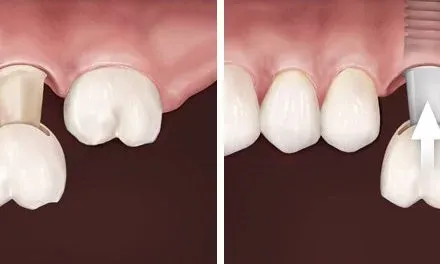
An implant is an artificial tooth root that is placed into the bone at the site of a missing tooth.
A crown is later fixed on top of it.
Simply put:
- the tooth is restored from root to crown;
- neighboring teeth are not affected.
An implant functions like an independent tooth — both in load distribution and sensation.
What is a dental bridge
A bridge is a construction that:
- relies on neighboring teeth;
- closes the gap between them.
To place a bridge, the adjacent teeth:
- are prepared (shaped);
- become supports for the structure.
A bridge can be a good solution, but it always involves treating healthy tooth tissue.
Key difference: briefly
Implant
An independent “tooth” that does not affect neighboring teeth.
Bridge
Relies on adjacent teeth and requires their preparation.
Load distribution
An implant transfers load to the bone, a bridge to the teeth.
Long-term perspective
Implants are more likely to preserve jawbone structure.
When a bridge may be justified
A dental bridge is not a “bad” option. In certain situations, it can be appropriate.
For example:
- neighboring teeth are already significantly damaged or covered with crowns;
- the patient wants a faster solution without a surgical stage;
- there are contraindications to implant placement;
- a temporary solution during ongoing treatment.
In these cases, a bridge can be a reasonable compromise.
When an implant is more often recommended
Implant placement is usually preferred when:
- neighboring teeth are healthy;
- preserving bone tissue is important;
- a long-term result is planned;
- the patient wants the most natural solution possible.
An implant does not overload adjacent teeth and helps prevent bone loss over time.
Impact on neighboring teeth — a key factor
This is one of the most underestimated aspects.
With a bridge:
- adjacent teeth are prepared;
- additional load is placed on them;
- problems with one support affect the entire structure.
With an implant:
- each tooth functions independently;
- neighboring teeth remain intact.
That is why we evaluate not only the “gap,” but the entire system.
Comparison by key parameters
| Parameter | Implant | Bridge |
|---|---|---|
| Preparation of adjacent teeth | No | Yes |
| Bone preservation | Yes | No |
| Service life | Long-term | Depends on supports |
| Surgical stage | Yes | No |
| Recovery | Longer | Faster |
Frequently asked questions
No. There are situations where a bridge is the more rational option. Everything is decided individually.
In most cases, yes. Implantation requires time for integration.
That’s normal. During the consultation, we discuss all options and choose the most comfortable path.
Short conclusion
An implant and a bridge are two different approaches, not “good versus bad.”
An implant:
- preserves neighboring teeth;
- functions as an independent tooth;
- is designed for long-term results.
A bridge:
- is faster;
- does not require surgery;
- is suitable in certain clinical situations.
The best solution is the one that suits you personally, taking into account your teeth, bone condition, and expectations.