
Why treat a cavity if the tooth doesn’t hurt?

Why treat a cavity if the tooth doesn’t hurt?
The question “If it doesn’t hurt, why treat it?” is completely normal.
Many people rely on how a tooth feels to decide whether it needs care.
As a practicing dentist, I hear this often.
But in dentistry, no pain does not mean no problem.
A cavity can grow quietly while the tooth looks calm from the outside.
Inside, the process is still moving forward.
This article is short and calm: read for a couple of minutes and it will make sense.
Why cavities often don’t hurt
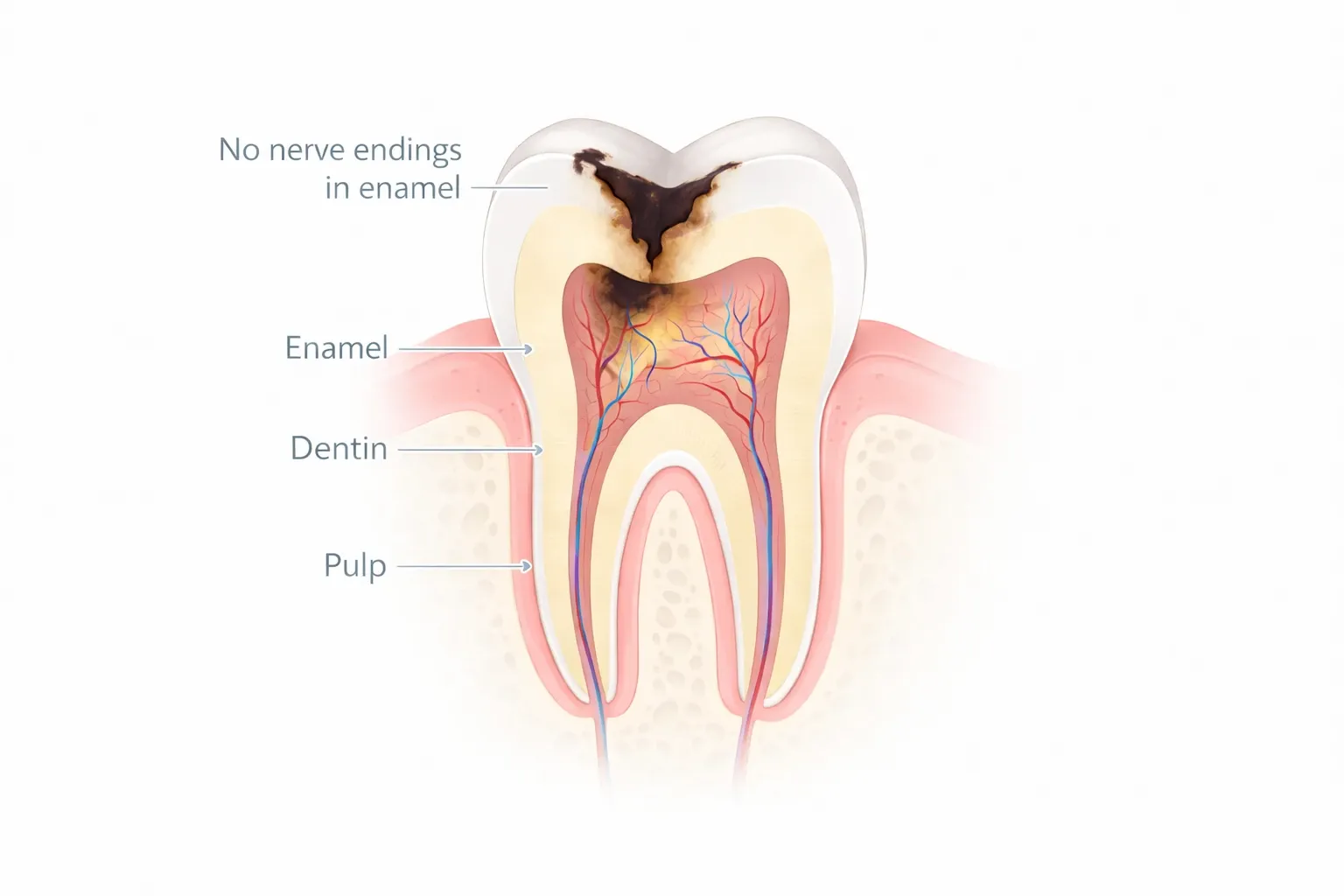
Enamel has no nerves.
That’s why early decay can exist without any symptoms.
While the process is shallow, most people feel nothing.
Pain usually appears later, when the damage reaches deeper layers.
This is not “luck.” It’s how the tooth is built.
That’s why cavities are often found during a routine checkup.
What is happening inside the tooth while it “doesn’t hurt”?
If we simplify, decay develops in stages.
Here is what that looks like in everyday terms.
Enamel
Damage starts on the surface, but there are no nerves here, so symptoms may be absent.
Dentin
The damage goes deeper and gets closer to sensitive tissue.
Closer to the nerve
The tooth may start reacting to cold or sweet, but not always.
Risk of pulp inflammation
The pulp is the nerve and blood vessels inside the tooth. When it becomes inflamed, treatment is more involved.
When and why pain appears
Pain is a signal of complications, not a “normal stage.”
Most often it appears when the process reaches the nerve or the tissues around the root.
Your dentist may use clinical terms, but the idea is simple:
- Pulpitis — inflammation of the nerve inside the tooth.
- Periodontitis — inflammation of the tissues around the root.
At this stage, treatment is more complex and takes more time.
How early treatment differs from late treatment
- Usually a simple filling is enough.
- The visit is shorter and easier.
- The intervention is minimal.
- Recovery is calm and predictable.
- Root canal treatment is often required.
- More steps and more time.
- Higher overall burden for the patient.
- Longer recovery.
What happens if a cavity is not treated
The process does not stop on its own and usually becomes more complicated over time.
This isn’t meant to scare anyone — it’s simply the typical logic of progression.
Possible outcomes:
- inflammation of the nerve;
- infection spreading beyond the tooth;
- a larger volume of treatment;
- risk of losing the tooth.
This doesn’t happen overnight.
That’s why regular checkups help prevent advanced stages.
Common patient questions
Unfortunately, cavities do not heal on their own. They may remain quiet for a while, but they continue to develop.
The process was superficial before, so the nerve was not involved. When decay progressed deeper, sensations appeared.
In very early stages, monitoring may be possible — but only after a dentist evaluates the risks.
Short conclusion
No pain is not a sign of a healthy tooth.
Early treatment is usually simpler, safer, and calmer for the patient.
Regular checkups help catch problems early and avoid complex procedures.
If you’re unsure, it’s better to come in for a consultation and discuss it calmly, without rushing.